
FBF #50: A Serial Procrastinator's Guide to Productive Writing
How I turned writing dread into daily discipline and how you can do the same

This week, I am trying something new: an audio version of the article, read by me. If you like this new feature, please let me know in the comments.
Most of us are drowning in procrastination. It steals our dreams.
Procrastination is delayed goals. It’s dying with a whole lot of wisdom inside of you that never gets released. It’s a silent thief of time leaving behind unrealized potential.
I have been a serial procrastinator for as long as I can remember. Nowhere was this more true than in the realm of writing.
In college, I had a policy: I would not start any paper 10-pages or fewer until midnight the night before it was due. By 8AM I usually had a great essay, but my gas tank was empty. This technique meant that writing activated my fight or flight response, and for years I had been fleeing.
Tim Ferris once said that “your superpower is very often right next to your biggest wound.” Writing is probably my single greatest creative gift, but years of procrastinating had turned it into a festering wound that I avoided at all costs.
Over the past 15 months, however, I have had a major breakthrough. In November 2022, I wrote roughly 30,000 words in my 30 College Essays in 30 Days series. I have published this longform Substack every Friday for the past 50 weeks.
All of this writing helped give me the courage to make other, even bigger changes, such as leaving my job and beginning my own business.
I am about to launch a class called “Barakah-Boosted Study Skills” in which my wife and I translate our insights and research about procrastination and productivity into language and activities that teenagers can use to achieve better results in less time by unlocking the hidden power of barakah.
In today’s edition of Five Before Five, I unveil five “slingshot strategies” I have used to land decisive blows against the Goliath of procrastination.
1. Ready-Fire-Aim
Getting started is the hardest part of any creative endeavor. Blank page syndrome or the feeling of paralysis when beginning a new piece, has aborted countless ideas before they ever saw the light of day.
Writers suffer from blank page syndrome because they are overwhelmed by the pressure to create something great. They have set unreasonably high expectations for themselves and are afraid that they won’t live up to past successes. This fear spirals into anxiety and self-doubt and inevitably leads back to the blinking cursor on a new document.

One way to short circuit blank page syndrome is to adopt the ready-fire-aim paradigm. Rather than trying to get all your ducks in a row and plan the perfect outline, just begin to write. Let the Ouija board of inspiration take over your pen and see where it leads.
Once you have “fired” and gotten some words on a page, you can better identify your target and refine your “aim” to achieve your desired outcome.
2. Leverage the Inverse of Parkinson’s Law
Many people need the pressure of a deadline to do their best work. Coffee-fueled all-nighters at the Science Center at Harvard were how I got my term papers done. When a deadline is looming, you have no choice but to get down to work—you have sucked all the oxygen away from the procrastination demon.
I used to hate the idea of letting a piece of writing take me weeks when I knew it could be done in a few painful hours if I created sufficient deadline pressure.
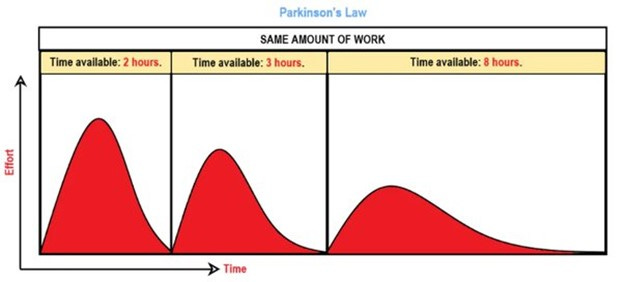
What I was really doing was leveraging the inverse of Parkinson’s Law. The law itself, first coined by British historian Cyril Parkinson in 1955, states that “work expands to fill the time available for its completion.” If you give yourself 8 hours to write a Substack, it’s going to take you 8 hours.
The inverse of Parkinson’s law would state “work contracts to fit into the time we allot for it.” This is a powerful concept and one that can greatly improve our productivity.
There are two tricks to leveraging the inverse of Parkinson’s Law:
Give yourself an internal deadline with teeth. I have created a “personal operating system” that I will publish this Substack every Friday and will send a high-quality email to my Five Before College list every Monday & Thursday. From next week, I plan to add a LinkedIn post every Wednesday.
Get busy. There is a paradox that the busier someone is the more time they seem to have to get things done. Humans are remarkable problem solvers. If you paint yourself into a corner, you’ll find a way out.
3. Stop Gilding the Lily
This phrase, coined by Shakespeare in King John, refers to the act of spoiling something that is already beautiful or perfect by trying to improve it.
Many writers become too precious with their work. They bang out a great draft in a burst of productivity, but then fiddle with it endlessly, often adding ornamentation to a piece that was already beautiful in its own right.
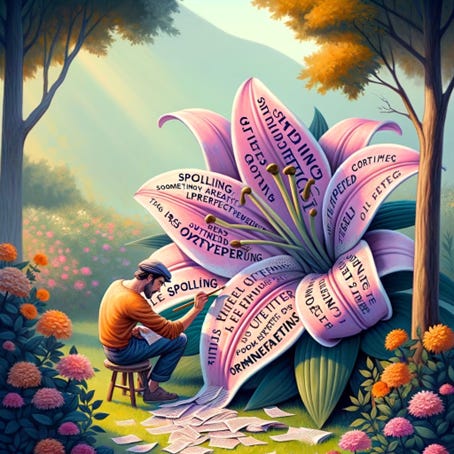
Some of the best writing advice I have gotten is “stop polishing, start publishing.”
Editing is, of course, critical to good writing, but it should almost always consist of subtraction, not addition. Chip away all the purple prose and glitzy adverbs until the lily can shine.
4. Steal Like an Artist
Austin Kleon, author of the amazing Show Your Work, begins his 2012 NYTimes bestseller Steal Like an Artist, with a quote from T. S. Eliot:

One of the things that holds writers back is the need to be “original.” They feel pressured to come up with novel ideas that no one has ever thought before. The reality is that all creative work builds on what came before.
Andre Gide once said, “Everything that needs to be said has already been said. But, since no one was listening, it needs to be said again.”
I am part of a Masterclass with internet writing masters Todd Brison and Tim Denning. Their initial free webinar featured a compelling slide that ultimately drew me into their world:
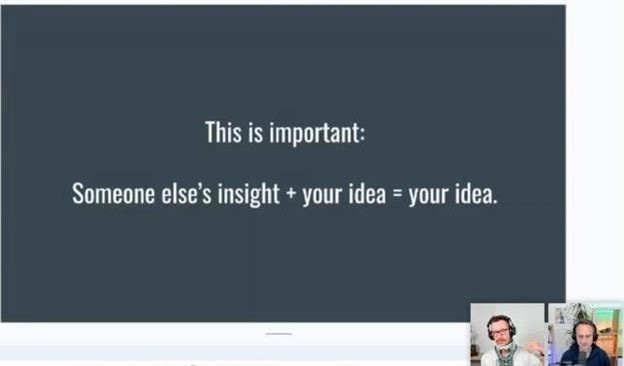
Our ideas have a genealogy—everything is derivative. Every new idea is just a mashup or remix of previous ideas. What I often find myself doing is filtering “western” productivity and business ideas through the lens of Islam to produce something with my own unique flavor.
5. Tap into the Barakah of the Early Morning
One of the best ways to overcome procrastination is to “eat the frog,” the single hardest thing that you have been dreading, first thing in the morning.
The Prophet (SAWS) made a special prayer for the early part of the day:

As Muslims we are encouraged to wake up in the last third of the night and pray tahajjud. At the very least, we are obligated to get up for fajr, the pre-dawn prayer.
One of my best pieces of advice to anyone struggling with procrastination is to write first thing in the morning. Whether it is a gratitude journal, “morning pages,” or an actual article for publication, try to find yourself with pen in hand or fingers on keyboard at sunrise.
If you made it to the end and found this article insightful, please warm my writer soul by clicking the heart button. And if you or anyone you know might be interested in our Barakah-Boosted Study Skills class, you can fill out this form to book a free 15-minute meeting with me to see if the course is right for you.
Great article, Br. Hamza. I was procrasinating in reading this article and had saved it in my tabs for some weeks; I'm glad I finally I read it this morning--insightful practical tips and inspiration! May Allah continue facilitate your efforts!
Some incredible advice here. Extremely helpful to someone like me who wants to write, but is constantly burdened with the thought of it. Thank you!